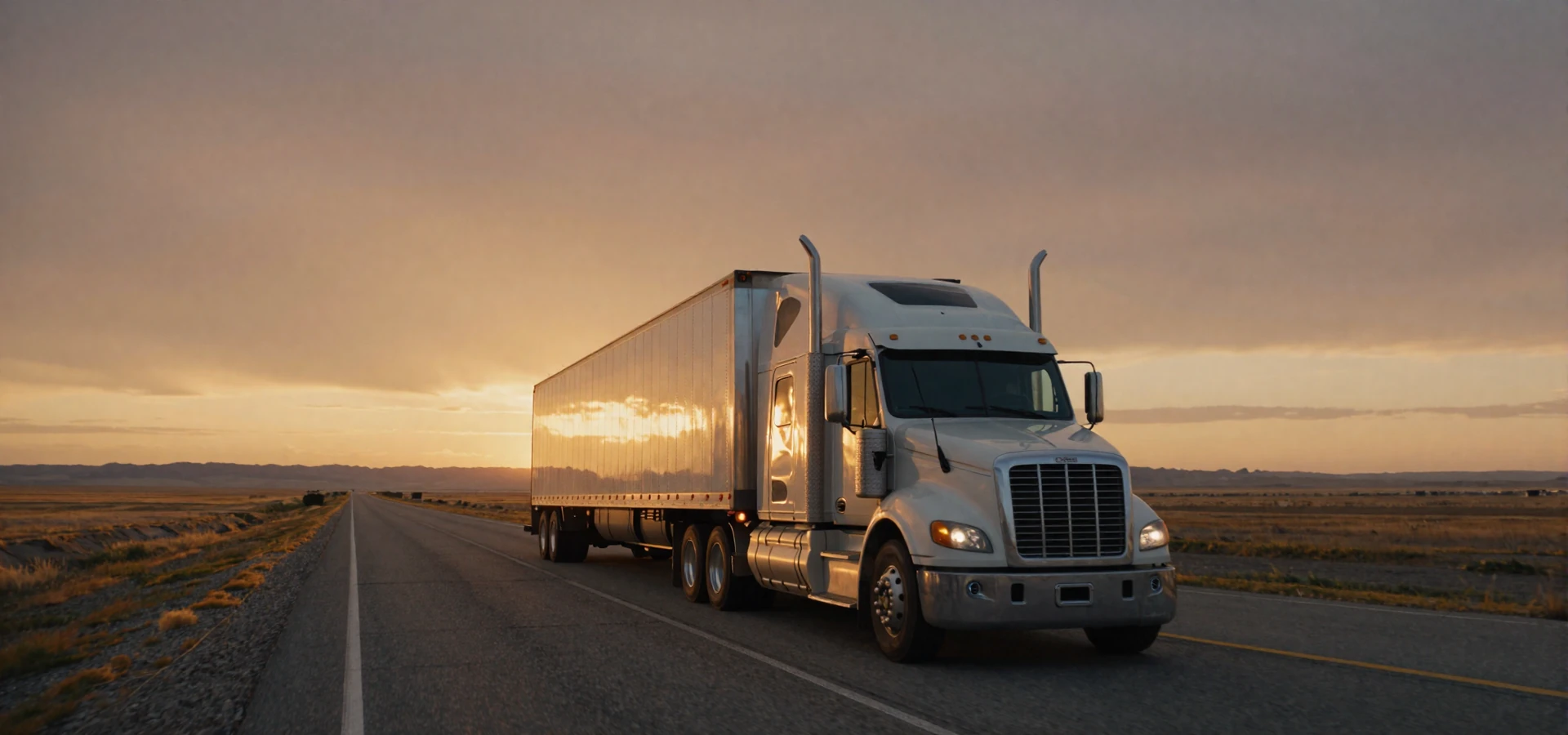
How to Date a Truck Driver: A Practical Guide for 2026
Seven honest rules for building something real with someone who lives 11 hours a day behind 18 wheels. Communication rhythms, independence, and home time done right.
Twenty hours alone every day. Seventy-hour weeks. A bunk five feet wide. This is what life of a truck driver actually looks like - and what romance on the road requires to survive it.
The life of a truck driver is not the open-road fantasy Hollywood sells. The average over-the-road driver spends 20 hours a day alone, logs 70 hours of work per week, drives 10-11 hours daily, and racks up roughly 125,000 miles a year (Dumb Little Man, January 2026). That much solitude rewires what dating and connection even mean. The lonely truck driver isn't a stereotype - it's a measurable condition, with 28% of drivers reporting chronic loneliness and 27% reporting depression (International Journal of Environmental Research). What follows is the honest version of how that reality reshapes romance on the road.
Strip the romance from the highway and a long-haul driver's day looks like this. Up at 5 a.m. in the sleeper berth. Pre-trip inspection in the dark. Eleven hours behind the wheel, broken only by a federally mandated 30-minute stop and whatever bathroom or fuel breaks the route allows. Park by 6 p.m. Eat in the cab or in a fluorescent-lit truck-stop diner. Sleep in a bunk five feet wide. Reset for ten hours. Repeat.
Within that day, the typical OTR driver speaks to another human face-to-face for less than an hour total. The shipping clerk at the dock. The cashier at the fuel desk. Maybe one other driver at the showers. That's it. Dispatch radios in. Family texts when they can. Otherwise, it's the road, the radio, and the sound of diesel.
"I'm a 33-year-old driver out of South Texas. I run a week at a time. My girlfriend just left me. Honestly, I'm used to it by now."
- Anonymous post, AllTruckJobs.com forum
That kind of plainness is the tone of the industry. Drivers don't dramatize the loneliness - they file it under cost-of-business. But the data shows the toll. The same Dumb Little Man review noted that drivers cover ~125,000 miles per year, the rough equivalent of circling the planet five times annually, almost entirely solo. No HR department, no team huddles, no Friday after-work drinks. Just lane lines, mile markers, and the dim glow of the dash at 3 a.m.
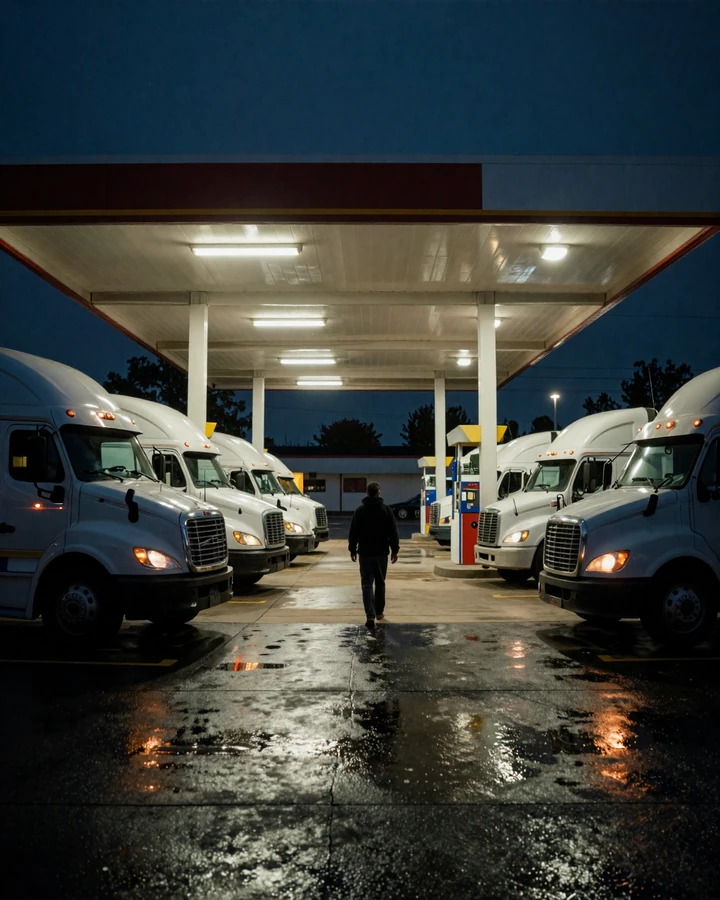
Four data points that explain why "lonely truck driver" is one of the most-typed phrases in trucking-related search.
If loneliness is the disease, truck stops are the unlikely vaccine. The modern American truck stop has quietly evolved into something closer to a tiny self-contained town - and the case study that proves it is Iowa 80 in Walcott, Iowa, the largest truck stop in the world.
Sitting at the Interstate 80 crossroads since 1964, Iowa 80 sprawls across 220 acres with more than 900 truck parking spots. After 28 expansions, the complex now houses eight restaurants, a 300-seat dining room, 16 diesel lanes, 42 gasoline islands, 24 showers, a 60-seat movie theater, a video-game arcade, a fitness gym, a chiropractor, a dentist, a barber shop, and a working trucking museum. It is open 24/7. It is open to everyone, CDL or not. Drivers route trips through Iowa 80 deliberately, the way road-trippers route through Las Vegas.
That cultural function is why the dating playbook for drivers looks different than for anyone else. The "third places" sociologists talk about - the coffee shops, gyms, and corner bars where strangers naturally bump into each other - for truckers, they collapse into the truck stop. It is the gym, the cafeteria, the cinema, and the social network in one fluorescent-lit footprint. Smart platforms built for the lifestyle, including TruckerMatch's Stopover Connect feature, treat these hubs as the actual map - matching people not by city zip codes but by shared stops along overlapping routes.
And Iowa 80 is just the headliner. From Jubitz in Portland to South of the Border in South Carolina, the country is dotted with mega-stops that function as accidental community centers. They are where the lonely truck driver stops being a statistic and becomes a person with options.
Take the daily reality - 20 hours alone, 70 hours worked, 7-14 days between home visits - and feed it into conventional dating, and the math breaks instantly. Mainstream apps like Tinder and Bumble assume two things that don't apply to drivers: a stable location and the ability to meet for coffee within 48 hours of matching. Strip those assumptions and the algorithm quietly de-ranks the profile. The driver disappears.
The relationships that survive are the ones that swap presence for predictability. Couples who lock in two daily windows - one morning ping, one parked-for-the-night call - outlast couples who try to text constantly. A landmark study of 500 occupations identified three predictors of relationship success that hold across every job type: communication quality, willingness to solve problems, and intentional time together. Drivers can deliver on all three; they just have to be intentional about it.
Loneliness research backs this up. People in long-distance relationships report feeling lonely "often" or "very often" at a rate of 66% - and the figure is similar for the truckers themselves. Both sides are isolated. Both sides need the same thing: a small, repeated ritual that says "I'm still here." A voice note from a rest area. A photo of the sunrise over the Cumberland Gap. A 20-minute call once the truck is parked and showered. That's romance on the road. It's not sweeping. It's structural.
The couples who fail tend to fail for one of two reasons. Either the non-driving partner expected a 9-to-5 rhythm and could not adapt, or the driver tried to hide the lifestyle on a mainstream app and got ghosted the moment reality landed. The fix in 2026 is simple: be a trucker openly. Read our guide on how to date a truck driver and our deeper breakdown of long-distance relationships with truckers.
Isolation isn't constant - it spikes. Drivers and partners who recognize the spikes in advance handle them better. Three predictable seasons hit hardest.
I-80 across Wyoming, I-90 across Montana, and the Northeast corridors turn into a slog from late November through March. Black ice, chain laws, 14-hour delays in Sidney or Cheyenne. Drivers spend more time parked, less time moving, and burn through phone battery faster. Schedule extra short check-ins through these months - not longer ones.
Thanksgiving, Christmas, and New Year are the three hardest weeks of the year on the road. Freight peaks. Home time gets sliced thin. Family gatherings happen without the driver. Couples who reframe these as movable holidays - celebrating on December 27 instead of December 25 - protect the relationship far better than those who fight the calendar.
February 14 lands in the slowest freight week of the year, which sounds helpful - until you realize it also means dispatchers route drivers into the longest, most thankless runs. Anniversaries fare worse: they almost never sync with home time. Pre-plan a small ritual that travels (a voice-note playlist, a synced movie night) instead of relying on physical proximity.
The HDS Truck Driving Institute frames loneliness as a manageable occupational hazard, not a personality flaw. Its recommendations align almost exactly with what working drivers say keeps them sane. None of the items below require an extra dollar of equipment.
The pattern is the same across every recommendation: small, repeatable, low-effort. The driver who tries to compensate for a 14-day absence with one massive grand-gesture weekend usually arrives home exhausted and disappoints everyone. The driver who sends a thirty-second voice note from Flying J at 7 a.m. - every single morning - builds something that lasts.
The questions readers and forum users ask most often about life on the road, loneliness, and what dating actually looks like from inside the cab.
Yes, in specific and predictable ways. The hardest parts are unpredictable schedules, missed events, and sleeping alone most nights. The road itself is not the relationship-killer - mismatched expectations are. Couples who pre-agree on communication windows, accept that holidays will move, and treat home time as protected mini-vacations consistently report long-term satisfaction comparable to general-population averages. The lonely truck driver stereotype is real, but it is also solvable.
"Lot lizard" is industry slang for a sex worker who solicits drivers in truck-stop parking lots. The term is widely used in CB chatter and on trucking forums, but it carries negative connotations and is not part of the dating vocabulary serious drivers use. The far more relevant 2026 vocabulary is route-based - "shared stop," "lane overlap," "home-base zone." Platforms built for the lifestyle deliberately steer clear of the lot-lizard era and frame meetings around legitimate truck-stop social spaces like Iowa 80, Jubitz, and Petro Stopping Centers.
Because the math is unforgiving. OTR drivers spend roughly 20 hours a day alone in or near the cab, work up to 70 hours a week, and stay out 7-14 days between home visits. Roughly 28% report chronic loneliness and 27% report depression. Mainstream dating apps then compound the problem by de-ranking profiles whose location changes nightly. The loneliness is not a character flaw - it is the predictable result of an occupation built around solitude, made worse by tools that were not designed for it.
It can, and the couples who succeed share a clear pattern. Three predictors of long-term success show up in study after study: high-quality communication, willingness to solve problems together, and intentional time spent together. Drivers can deliver on all three with structured daily check-ins, voice notes during downtime, and protected home-time rituals. The relationships that last are not the ones with the most contact - they are the ones with the most consistent contact.
Three places, in roughly this order. First, niche dating platforms built around route matching rather than static zip codes - TruckerMatch is the leading example in 2026. Second, truck-stop social spaces like Iowa 80, where restaurants, gyms, and lounges create natural conversation moments. Third, the broader trucking community: industry events, CB-radio groups, and Facebook groups for OTR partners. Mainstream apps remain the worst option because their algorithms penalize the very thing that defines a driver: constant movement.
Less stuff, more ritual. A pre-recorded voice-note playlist that plays one message per day of a long haul. A small framed photo for the dash. A subscription to an audiobook service. A shared Spotify playlist updated weekly. Tangible gifts are nice, but the cab is already cramped. The gifts that survive a 14-day run are the ones that ride along intangibly - sound, story, and the sense that someone at home is paying attention.
Three more pieces from the Road Pulse Blog that pair naturally with this one.
 Advice
Seven honest rules for building something real with someone who lives 11 hours a day behind 18 wheels. Communication rhythms, independence, and home time done right.
 Advice
Three research-backed strategies for couples running 1,800 miles apart most weeks - balanced communication, structured independence, and dependable video routines.
 Industry
Algorithmic discrimination, the explanation cycle, and the static-location bug that makes Tinder unusable for anyone whose home address changes nightly.