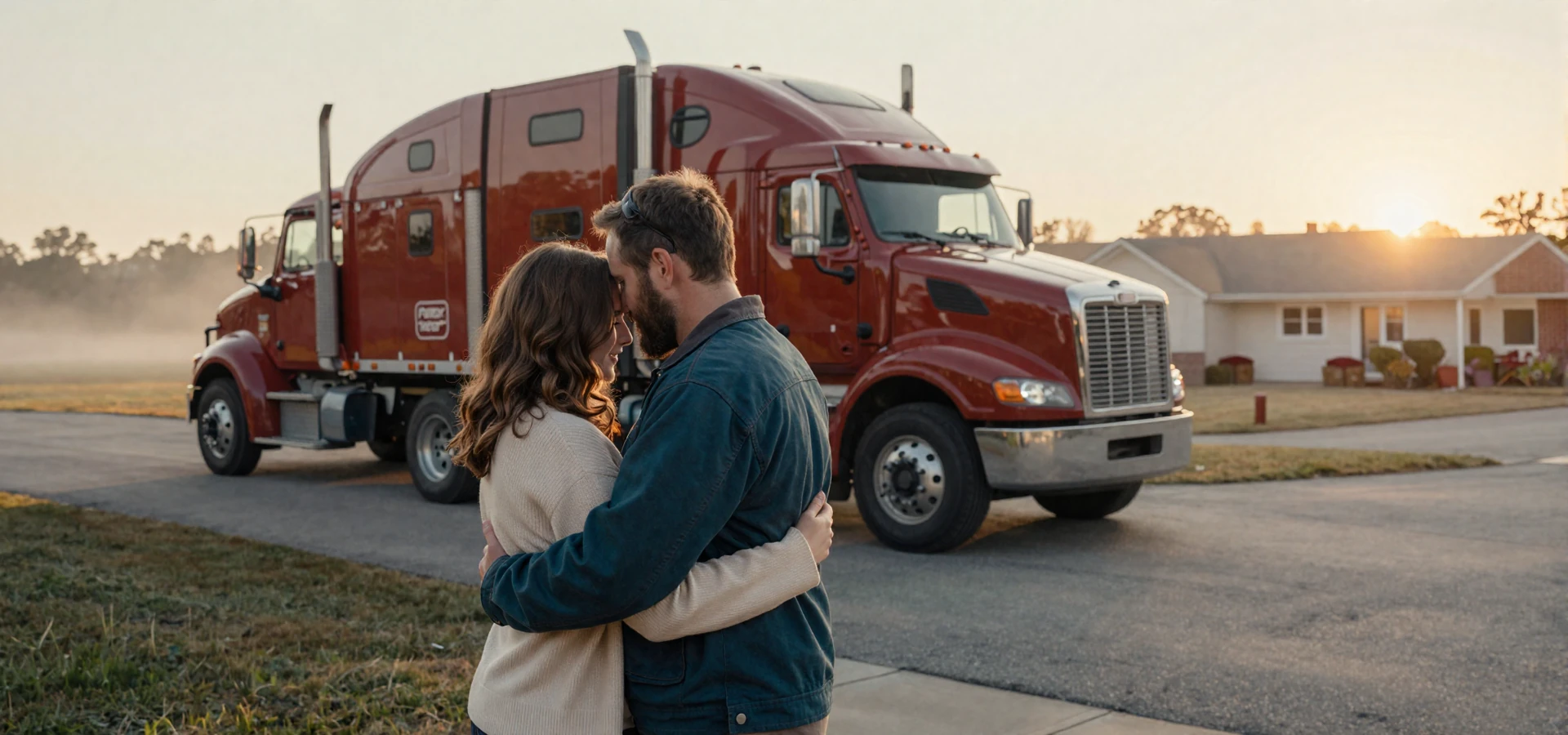
How to Date a Truck Driver: A Practical Guide for 2026
Seven honest rules for building something real with someone who lives 11 hours a day behind 18 wheels. Written for partners who want it to work.
A practical playbook for partners married to a truck driver - built on research, real OTR couples, and the small daily habits that keep love steady across 1,800 miles.
Your driver just pulled out of the driveway for another 12-day run. The house is quiet. Your phone is already lighting up with the first dispatch update. If you're married to a truck driver - or your boyfriend is a truck driver and you're learning what that actually means - the long-haul stretches don't have to feel like waiting. The strongest OTR couples treat absence as a system, not a punishment, and they win at it through three specific habits.
Research on long-haul relationships keeps surfacing the same three predictors. They are simple to name and brutal to execute consistently - which is exactly why couples who nail them outlast couples who don't.
Not how often you talk - how present you are when you do. One focused twenty-minute call after the truck is parked outperforms six interrupted texts during a busy dispatch day. Voice notes carry tone, and tone is what dies first in plain text.
OTR life throws curveballs weekly - collapsed home time, broken appliances at 2 a.m., a dispatcher who reroutes through three states. Couples who treat problems as joint puzzles, not blame events, build the muscle that 14-day separations require.
Time together is rare, so it has to be deliberate. The partners who say "we just make it work" actually plan it carefully - protected meals, slow mornings, one shared activity that has nothing to do with chores or family obligations.
Prime Inc. team driver James Burrow has been with his wife Leslie for four years while raising kids - Leslie chose this lifestyle deliberately after nine years of watching him drive. Their success wasn't luck. It was a deliberate decision to communicate daily, problem-solve together, and protect home time. It's the same pattern researchers keep finding across thousands of trucker households.
Daily contact is non-negotiable in OTR relationships - but the goal is connection, not interrogation. Couples who treat the call as a debrief, not a status report, report dramatically higher satisfaction. Inform your driver about life at home: what the kids did at school, who called, the small wins of an ordinary Tuesday. Drivers grieve missed birthdays and Little League games more than partners realize. A two-minute voice memo about your daughter's first lost tooth can reset an entire shift.
The flip side is the partner at home needing to know the truck reached a safe overnight stop. That ritual - a one-line "parked, fed, love you" text - does more emotional work than ten poetic paragraphs. It says: I'm safe, the day worked, we close the loop together. Modern messaging apps and video calling have made this rhythm easier than at any point in trucking history. There is no good excuse for going dark by choice.
"On certain stretches of I-70 the signal drops for hours. We learned to predict the dead zones. Now when he goes quiet between Denver and Grand Junction, I don't spiral - I know exactly when his voice will come back through."
- Wife of a regional flatbed driver, 6 years married
Here's the thing about routine signal drops: if your driver runs predictable lanes, you'll start memorizing the radio-silence windows. That's not abandonment, that's geography. Couples who learn the map together stop reading silence as a sign of trouble. And on the calls themselves - even when the conversation feels boring, even when nothing happened, do not skip a day. The skip is what damages the relationship, not the dullness. The ordinariness is the whole point.
Niche apps designed for the lifestyle now build this rhythm directly into the product. TruckerMatch's Shift Chat Mode, for example, adapts the interface depending on whether your partner is rolling or on a 10-hour reset, so the daily ritual fits the schedule instead of fighting it.
Relationship coach Olivia Smith named something every OTR couple knows but rarely articulates: the re-entry phase. When a driver pulls into the driveway after two weeks of hyper-vigilant solo work, they don't flip a switch into husband-and-father mode. They decompress - slowly. The brain that just spent fourteen days scanning mirrors and reading weather can't instantly handle a packed family dinner, three errands, and an in-law visit.
Smart partners give that re-entry window oxygen. The first eight to twelve hours home are for sleep, a quiet meal, a shower in your own bathroom, and quiet conversation. Not a honey-do list. Not a kid-sport tournament. Not your sister-in-law dropping by. Those things have their place - usually starting on day two, after the driver has slept twice in their own bed and remembered how civilian life feels.
The driver also has a job in this phase. Decompression cannot become disappearance. After the initial reset window, presence matters more than productivity. Be in the room. Phone down. Eye contact. The most lasting OTR couples describe re-entry as a small ritual - not a coincidence of timing, but a deliberate handover from road-self to home-self.

Conventional couples build intimacy through proximity - two hours together every evening, the same coffee shop on Saturday morning, the small repetitions that compound. OTR couples don't get that volume, so they engineer rituals instead. A ritual is a small, repeatable, protected event that signals "we are us" no matter how disrupted the schedule gets. The most resilient trucker couples we've interviewed all share some version of the same playbook:
The mistake most couples make is trying to do everything during home time. Catch up on bills, see both families, fix the leaky faucet, host the cookout you postponed. By day three the driver is more exhausted than when they pulled in. Rituals beat to-do lists. Choose two or three from the list above, protect them with militant discipline, and let everything else flex.
The first two years I treated his home time like a window I had to fill. Errands, family dinners, the honey-do list, the kids piled in every room. He came home exhausted and left exhausted. Year three we flipped it. First night is dinner and bed, full stop. Second day is one outing - just us. Family gets day three. I stopped asking him to be a husband, dad, handyman, and son-in-law in 72 hours. Our marriage steadied within a month.
Long-haul driving punishes the body. Sitting eleven hours a day, eating truck-stop food, broken sleep in a cab - the cumulative toll is real. Smart couples turn shared physical activity into a relationship anchor and a health intervention at the same time. When the driver is home, hiking, walking the neighborhood after dinner, even a simple morning stretch routine together does more than any candlelit dinner. Movement releases the tension that two weeks of grade-pulling builds up, and shared movement makes the partner part of the recovery.
Here's where it gets interesting: physical connection doesn't have to require physical presence. Some couples sync workouts across the miles - same 30-minute walk at the same evening hour, voice call running through earbuds the whole time. Others share step counts via fitness apps and gently compete week to week. One couple we spoke to reads the same book aloud over evening calls, each from their own bedroom or sleeper berth. It sounds small. Done daily for a year, it becomes a foundation.
For the driver specifically, even ten minutes of post-park stretching outside the cab and a 20-minute walk around the truck stop pays huge dividends - both physically and mentally. Partners who gently champion these habits without nagging become the reason their driver outlasts the industry average for health. That's love expressed through schedule and structure, which is exactly how OTR love has to work.
The questions partners of OTR drivers ask most often - answered with research, lived experience, and zero sugarcoating.
It is harder than a conventional relationship in specific, predictable ways - unpredictable schedules, missed events, and physical absence - but easier in others. Research across 500 professions identified three success predictors that have nothing to do with the job: communication quality, willingness to solve problems together, and intentional time investment. Couples strong in all three report long-term satisfaction comparable to general population averages, even with 14-day separations.
Yes, in the same logistical sense - but the relationship itself is often emotionally simpler than dating someone with a 9-to-5. There is less daily friction. Reunions stay genuinely exciting. The challenge is adapting to delayed responses, flexible holidays, and being content with your own company for stretches. People who already value independence settle into the rhythm quickly. Read our full how-to-date-a-truck-driver guide for the day-one playbook.
Three habits do most of the work. First, a daily check-in ritual - typically one short morning ping and one substantial evening call after the truck is parked. Second, a planned re-entry routine that gives your driver eight to twelve hours to decompress before the calendar takes over. Third, two or three protected home rituals - an arrival meal, a slow morning, a no-chores date night - that anchor every visit. Skip the to-do list. Protect the rituals.
Build a life that holds together for two weeks at a time. Friends, hobbies, a career, your own routines. Loneliness spikes when absence feels like a void to fill instead of structured solitude. Couples who thrive describe the apart-time as restorative, not punishing. Lean on community - including other partners of drivers, online or local - because nobody else fully understands the lifestyle, and the validation of "yes, that is also my Tuesday" is enormous.
The re-entry phase is the transition period when a driver comes home from a long run. After two weeks of hyper-vigilant solo work, the brain cannot instantly switch into family-and-social mode. The first eight to twelve hours home should be low-demand - sleep, a quiet meal, a real shower, quiet conversation. Couples who honor the re-entry window report dramatically smoother home time. Partners who pack day one with errands and family visits set themselves up for resentment by day three.
They can. Reported divorce rates among truck drivers range from 19% to 40% depending on the study and dataset, which is wide but not dramatically worse than other demanding professions. Ellen Voie's research on women married to professional drivers concluded that relationship strength is not determined by miles or hours apart - it is determined by communication, problem-solving, and intentional time. Marriages that fail in trucking almost always do so because one or both partners expected a conventional schedule, not because of the road itself.
Two structured contacts per day is the rhythm most OTR couples settle into - a short morning check-in and a longer evening call once the truck is parked. Supplement those with voice notes and texts during natural downtime, but avoid expecting live answers during active driving. Quality beats quantity. Skipping a day, even when the day was boring, is what damages the relationship - not the brevity of the call.
Three more guides from the Road Pulse Blog that pair naturally with this one.
 Advice
Seven honest rules for building something real with someone who lives 11 hours a day behind 18 wheels. Written for partners who want it to work.
 Advice
Three research-backed strategies - balanced communication, structured independence, and video routines - for couples running 1,800 miles apart most weeks.
 Lifestyle
Twenty hours alone per day. Seventy-hour weeks. Truck stops as accidental social hubs. How road lifestyle reshapes what dating even looks like.