
How to Date a Truck Driver: A Practical Guide for 2026
Seven honest rules for building something real with someone who lives eleven hours a day behind 18 wheels. Communication, independence, home time, and the pros and cons no one warns you about.
Three research-backed strategies for couples running 1,800 miles apart most weeks - plus the tools, rituals, and honest trade-offs that turn an OTR schedule into a relationship that lasts.
Dating a long-distance truck driver isn't a temporary phase you wait out - it's a permanent operating rhythm. Where conventional long-distance couples count down to the next visit, OTR couples settle into 7-to-14-day cycles of absence followed by 2-to-4-day reunions. The relationships that thrive treat distance as the default state, not the exception, and build their entire communication style around that reality.
Most long-distance guides assume two things: a fixed end date, and predictable communication windows. Trucker LDRs blow up both. There is no end date - your driver isn't graduating, isn't transferring, isn't finishing a contract. The road is the job. And communication windows shift weekly depending on cargo, dispatch, weather, and Hours of Service rules that don't care about your dinner plans.
The everyday texture is unfamiliar to people coming from conventional LDRs. Reply times can stretch six to ten hours mid-shift. Confirmed home time gets cancelled on a Wednesday afternoon because a load got rerouted to Memphis. Anniversaries, birthdays, and holidays migrate to whichever calendar day the schedule allows. Partners describe a documented form of low-grade emotional burnout - not from conflict, but from the constant micro-uncertainty.
What separates couples who flourish from couples who fracture is a single mental shift. The thriving couples stop framing absence as a problem to be fixed and start treating it as the rhythm to design around. The struggling couples keep waiting for the lifestyle to change. It won't. Dating a truck driver works only when both partners accept the rhythm as permanent.
| Factor | Standard LDR | Trucker LDR |
|---|---|---|
| End date | Usually fixed | None |
| Cycle length | Months | 7-14 days |
| Reply latency | Hours | Up to 10+ hrs |
| Schedule fixed? | Mostly yes | Rarely |
| Holidays on date? | Usually | Often shifted |
Trucker LDRs aren't just emotionally harder - they're statistically harder. Here's what peer-reviewed research, industry surveys, and community forums actually report.
The most counterintuitive lesson in trucker LDRs comes straight from the TruckersReport community: over-communicating is more damaging than under-communicating. Partners at home who try to fill every quiet moment with check-in texts overload a driver who is white-knuckling an unfamiliar mountain pass - and overload themselves while they're at it. The result is two people who feel more distant after every conversation, not less.
The pattern that actually works is structured and asymmetric. Give your driver the standing right to call you any time - emergencies don't schedule around HOS. In return, accept that proactive communication should match the windows when driving is paused: pre-trip morning, mandatory 30-minute break, and the post-park hour at night. Outside those windows, text freely but expect delayed answers and stop reading silence as rejection.
"I used to text him every two hours and feel hurt when nothing came back. Once I switched to one voice note at lunch and a real call after he parked, everything got easier. He had room to drive. I had room to live my day. Both of us stopped feeling like we were failing each other."
- Partner of a regional dry-van driver, 2 years together
This is also why platforms built for the lifestyle matter. TruckerMatch's Shift Chat Mode adapts the interface based on whether your driver is rolling or resting - quiet notifications during active driving, full-feature messaging when the truck is parked. It removes the guessing game from both sides.

The healthiest trucker couples share a quiet truth: they don't need each other every day, and they're proud of it. When the CDL holder is on a run, the partner at home isn't waiting - they're running a household, holding down a career, seeing friends, and protecting their own routines. Independence isn't a workaround for absence. It's the foundation that makes the absence livable.
This reframe matters because it kills the most common failure pattern: the partner who slowly shrinks their life to "be available" whenever the driver might call. Six months in, they have no hobbies, no social circle, and a simmering resentment they can't name. Drivers, for their part, often feel guilty for the shrinking - which makes them communicate less, not more. The whole thing spirals.
Practically, this looks like keeping a standing weekly dinner with friends, joining a class that meets every Tuesday, or building a side project that fills the quieter weeks. When your driver pulls into the home base on Friday, you're not depleted from waiting - you're a full person showing up to a partner you actually missed. That's the energy reunions are supposed to have.
The TruckersReport advice column makes a point most LDR guides miss: video isn't just for date-night calls. The strongest trucker couples use video to share ordinary moments - playing the same online board game from opposite ends of the country, watching the same movie on a synced stream, or just leaving a video call open while one cooks dinner and the other eats truck-stop chicken in the sleeper berth.
The mechanic works because it replaces the thing OTR couples lose first: the unremarkable shared time. Couples who live together don't remember every Tuesday - they remember the texture of being in the same room while nothing happens. Video routines rebuild that texture, even imperfectly.
Niche dating platforms now build these video patterns directly into the product. TruckerMatch's Road Pulse Feed lets your driver share quick clips from a sunrise pull-off or a scenic detour - small moments that don't justify a phone call but accumulate into a shared sense of life.
The right stack of apps turns scattered downtime into real connection. Here's what couples running OTR schedules actually use in 2026.
FaceTime, WhatsApp, and Signal for high-quality video calls when the truck is parked. Voicemail-style voice notes for hands-free moments during driving - they carry tone in a way texts never will.
Google Calendar or TimeTree synced between both partners. Drop dispatch home-time estimates the moment they land. Plan reunions, anniversaries, and household admin in one place so nothing gets missed across the silence.
Netflix Teleparty, Prime Video Watch Party, and Board Game Arena for synced entertainment over weak truck-stop Wi-Fi. Built-in chat keeps the running commentary alive without burning mobile data.
General messaging apps assume both users are stationary and connected. Trucker-specific platforms like TruckerMatch are built around the realities of weak roadside Wi-Fi, route changes, and HOS-driven downtime - so the connection holds even when the bars don't. Read our breakdown of the best dating apps for CDL drivers for a side-by-side comparison.
Year one was rough. I tried to text him every hour and we both burned out. Year two we set rules - one call after he parks, voice notes during the day, video board games on Wednesday nights, no scheduled calls during driving. Year three feels almost normal. I run my life, he runs his lane, and every other Friday we get this beautiful 72-hour window where we actually choose each other again. We have something most couples I know don't - we never get tired of each other.
The questions partners ask most often about long-distance trucker relationships - answered honestly with input from drivers, partners, and relationship researchers.
It is harder than a conventional relationship in specific ways: missed events, sleeping alone most nights, and unpredictable schedules. It is also easier in other ways - drivers tend to be financially stable, loyal, and emotionally low-maintenance because they do not have bandwidth for daily drama. Research across 500 occupations found that communication quality, problem-solving willingness, and time spent together are the three biggest predictors of relationship success - none of which are uniquely difficult for trucker couples once both partners accept the rhythm.
Yes, especially in the first 6-12 months while both partners adjust to delayed responses, moving home time, and weeks of physical separation. Couples who establish clear communication rhythms, build independent personal lives, and treat home time as protected report long-term satisfaction comparable to general population averages. The difficulty is mostly logistical and front-loaded - once the rhythm clicks, the relationship runs smoothly. For a deeper breakdown, see our guide on how to date a truck driver.
Three habits separate the couples who last from those who don't: balanced communication (two structured calls per day, not constant texting), genuine personal independence (each partner runs a full life solo), and shared video routines (synced streaming, board games, open-window calls during downtime). Avoid the trap of trying to recreate a conventional relationship across distance - design something new that fits the OTR schedule instead.
Most successful OTR couples settle on two structured calls per day: a short morning ping to share the day's plan and a longer evening call after the truck is parked. Voice notes and texts fill in during downtime. Live answers during active driving are unsafe and unrealistic - federal Hours of Service rules and hands-free laws make sustained phone use illegal in most states. Quality beats quantity: one focused 20-minute call beats six interrupted exchanges.
Long-haul drivers spend up to 20 hours per day alone in the cab and work an average of 70 hours per week. Roughly 28% of drivers report chronic loneliness and 27% report ongoing depression symptoms, according to research published in the International Journal of Environmental Research and Public Health. Truck stops provide brief social contact, but the cumulative isolation across 7-to-14-day OTR runs is real - which is why dating platforms built around route matching, like TruckerMatch, exist in the first place.
Yes. Divorce rates among U.S. truck drivers fall between 19% and 40% depending on the study, with the lower figure (19.14% from a 2010 survey) actually below the national average. Couples who maintain balanced communication, build independent lives, and reframe home time as protected report multi-decade relationships. The relationships that fail almost always do so because the non-driving partner expected a conventional schedule, not because of the road itself.
For most partners, it is not the absence itself - it is the unpredictability. Confirmed home time can collapse on a Wednesday afternoon. Anniversaries slide to whichever calendar day the dispatcher allows. Friends and family who do not understand the lifestyle keep asking when the driver will "be home for good." Couples who develop a one-line answer to that question and treat schedule shifts as normal - rather than personal failures - adapt fastest.
More guides from the Road Pulse Blog for partners building a life around the road.
 Advice
Seven honest rules for building something real with someone who lives eleven hours a day behind 18 wheels. Communication, independence, home time, and the pros and cons no one warns you about.
 Advice
The re-entry phase after a 14-day run is often harder than the absence itself. Daily check-ins, home rituals, and physical activities that keep OTR couples synced through every cycle.
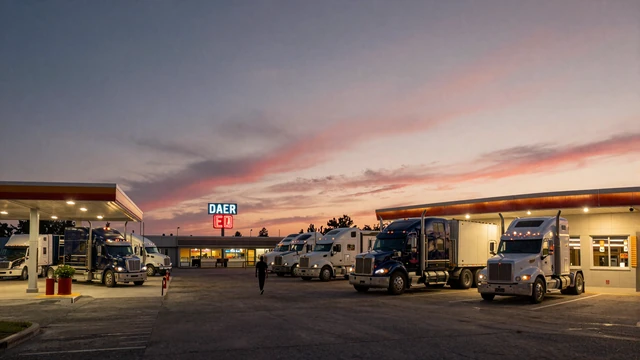 Lifestyle
Twenty hours alone per day. Seventy-hour weeks. Truck stops as accidental social hubs. How road lifestyle reshapes what dating even looks like for the people behind the wheel.