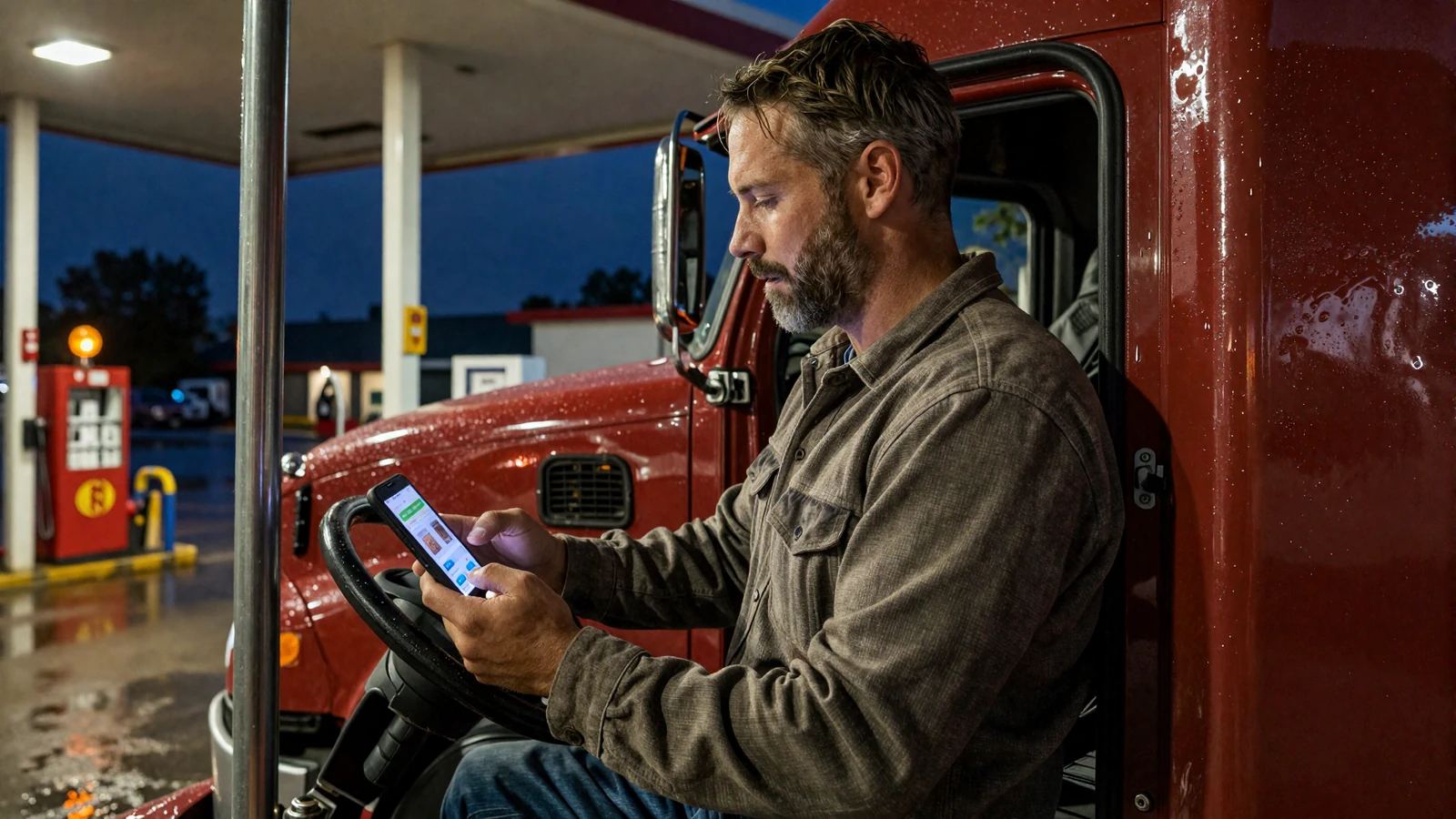
Best Dating Apps for CDL Drivers in 2026
Head-to-head review of the top trucker dating platforms - TruckerMatch, TruckDriverDating.site, LaneMate and more. Route matching, verification, mobile UX, the full breakdown.
Tinder. Bumble. Hinge. Match. They were built for office workers who sleep in the same bed every night. If you run OTR, the algorithms arent neutral - theyre structurally working against you. Here is the honest breakdown.
You are not bad at dating. You did not write a weak bio. You are not unphotogenic. The reason your match count cratered the day you went OTR is structural - mainstream dating apps were engineered around a stable home location, fast reply times, and "let's grab coffee Friday" availability. None of those describe a CDL-A driver running 2,700 miles a week.
The rest of this article walks through each of those four problems in detail - with data - and ends with what to do instead. If you've already deleted Tinder twice and are wondering whether the niche category is actually different, skip to Why Niche Platforms Solve What Tinder Can't.
Mainstream dating apps prioritize accounts that respond quickly and can plausibly meet within a few days. That's the entire ranking signal in plain English. When you're 800 miles from a match and the soonest you can be back in their city is two weeks out, the recommendation engine quietly drops your visibility. The algorithm isn't malicious - it's optimizing for "successful first dates," and you are not eligible.
The location problem compounds it. Tinder is location-based and refreshes your match pool to whichever city you're currently passing through. Useful in theory; in practice it means you build a connection with someone in Phoenix, drive eight hours overnight, and the next morning your matches reset to Albuquerque. Tinder reported a 9% year-over-year decline in monthly active users in 2025 as users - many of them mobile-lifestyle professionals - abandoned the platform for niche alternatives.
"Mainstream algorithms read a moving location as a signal of either a tourist or a fake account. There is no third category for someone who legitimately sleeps in a different state every night."
- TruckerMatch Editorial, on the structural bias of generic dating apps
Bumble adds another layer. Its 24-hour reply window is designed to filter out low-effort matchers; for an OTR driver running an 11-hour HOS shift, that timer expires while you're still behind the wheel. The match disappears. You did nothing wrong - the platform just decided you weren't trying hard enough.
Even when the algorithm does cough up a match, the conversation runs into the same wall every single time. She asks if you want to grab a drink Friday. You explain you're in Joplin until Sunday morning. She asks about Sunday. You explain that the reload puts you in Memphis by Monday night and you won't see your home base for another nine days. She types "oh, interesting!" - and ghosts.
Then you do it again. With the next match. And the next one. The pattern has a name on driver forums: the explanation cycle. It's not that the women are uninterested or rude - they signed up to a general dating app for the implicit promise that the people in their feed live near them and are available to meet. Your existence violates that promise, and the work of re-pitching your entire lifestyle every Tuesday becomes its own form of exhaustion.
The data backs the burnout. Average dating-app session length fell from 13.21 minutes in 2024 to 11.49 minutes in 2025 (Business of Apps, 2026) - even general users are running out of patience. For drivers carrying the additional friction of the explanation cycle, the math is worse. Roughly 80% of dating-app users delete the app within three months of installation, and our informal polling of driver Facebook groups suggests CDL holders hit that uninstall point closer to six weeks.
Here's the thing: the explanation cycle isn't a communication problem you can solve with a better opening line. It's a venue problem. You're trying to find someone who already understands your schedule on a platform where, by definition, nobody does.
The decline of mainstream dating apps is not anecdotal. The data has been pointing the same direction for two straight years - and it's worse for users with non-standard schedules.
Read the middle number carefully. A 1-in-100 conversion is the average across all male users on Tinder - drivers, who get suppressed visibility on top of that baseline, run materially worse odds. Combine 25% ghosting rates on the matches you do get with a 9% drop in Tinder's monthly active users, and the picture is unambiguous: the platform isn't broken because of bad luck. It's broken because the premise no longer fits your life.
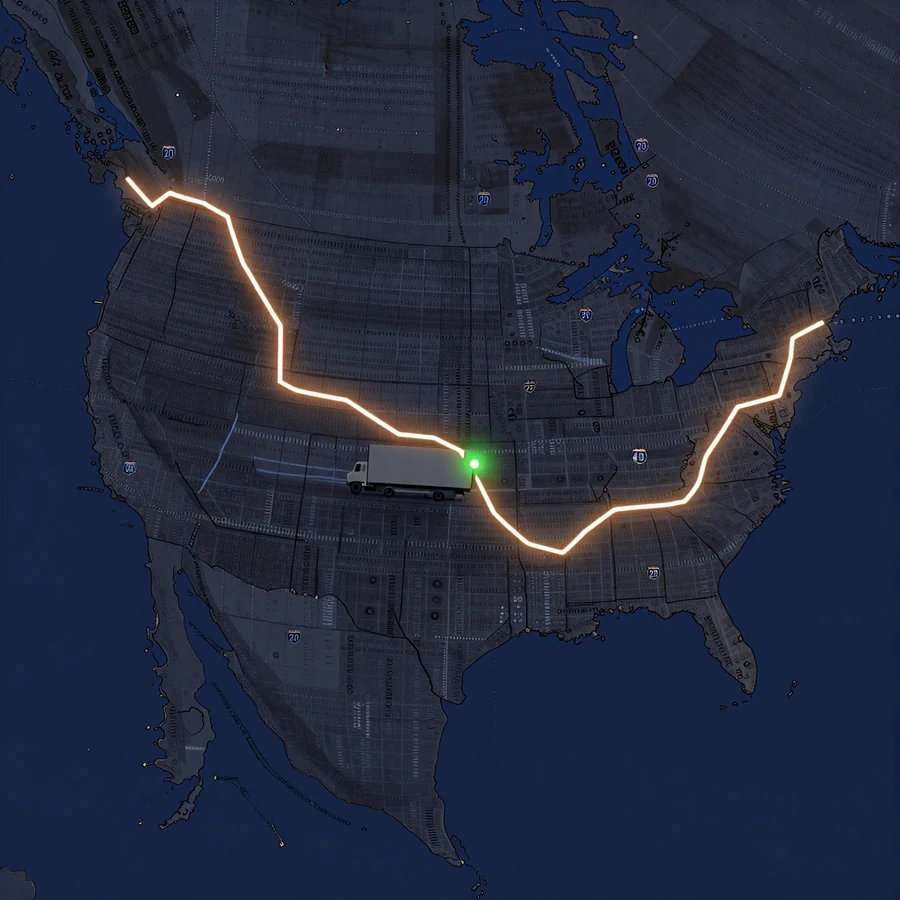
Every major dating app uses your current GPS coordinate as the primary input to its matching algorithm. That works fine for a software engineer in Austin whose location varies by twelve miles a week. It is functionally broken for a reefer hauler who is in Dayton on Monday, Toledo on Tuesday, and Indianapolis on Wednesday.
The fix isn't a setting. It's a different architecture. Route-aware matching - pioneered by TruckDriverDating.site and refined in TruckerMatch's Route Matching Engine - lets you input your home base, your typical lane, and your upcoming destinations. The system then surfaces matches whose lives intersect yours, not whose zip code happens to be twelve miles away on a map you'll never visit.
Combine that with Stopover Connect, which alerts you when another user has pinned the same overnight (Iowa 80, Petro Effingham, South of the Border) within 24 hours of your planned rest, and the abstract problem of "long distance" becomes the concrete opportunity of "coffee at exit 284 tomorrow morning at 7am." That is what you have been missing.
Why does this matter? Because once the architecture treats your movement as the input rather than the obstacle, the explanation cycle ends. She already sees your route. You both already know you'll be in the same parking lot Thursday night. The conversation skips straight to the part where you find out whether you actually like each other.
The niche dating segment is growing roughly 15% faster than mainstream apps year-over-year, and the trucker subcategory is one of the fastest-moving slices of that growth. Three structural advantages explain it.
Built around lane overlap, not static zip codes. Enter your home base and typical run; the system surfaces people whose travel paths intersect yours. Movement becomes a feature, not a downrank signal.
Everyone on the platform already knows what OTR, regional, and home base mean. No explanation cycle. No need to defend your schedule on the third date. The lifestyle is the shared baseline, not the friction.
Mandatory CDL-tier and photo verification cuts romance-scam exposure dramatically. Driver and partner accounts are both verified - not opt-in, not optional. Real profiles, real people, real routes.
There's a fourth advantage worth naming: asynchronous communication is the norm. On general platforms, a four-hour reply gap reads as disinterest. On a trucker-specific platform, it reads as "she's driving - she'll voice-note me back at the next rest." The cultural expectation is baked into the design. That alone removes more friction than any premium feature could.
The trade-off, honestly, is pool size. A general app has more users in any single zip code. A niche platform concentrates fewer users along the corridors that actually matter to you. If you live in Manhattan and don't drive a truck, Tinder is correct for you. If you run I-40 weekly out of Dallas, the math reverses.
The questions truck drivers ask us most often about general dating apps and the niche alternative.
Yes. The dedicated trucker dating category includes at least ten platforms as of 2026, with TruckerMatch, TruckDriverDating.site, and LaneMate leading on combined criteria of route matching, verification, and mobile UX. These platforms are purpose-built around the constraints of CDL life - changing locations, irregular reply times, planned truck-stop overnights - rather than treating those constraints as friction to be ignored. See our full comparison in Best Dating Apps for CDL Drivers.
Yes, several. The strongest options for 2026 are TruckerMatch, TruckDriverDating.site, and LaneMate. The differences come down to three things: whether route matching is truly lane-aware or just basic zip-code filtering, whether verification of both drivers and partners is mandatory or optional, and whether the mobile interface performs well on the weak Wi-Fi typical at truck stops. TruckerMatch is the only platform that scores well on all three.
The same platforms work for female CDL drivers as for male - TruckerMatch, LaneMate, and TruckDriverDating.site all support female drivers seeking either other drivers or non-driving partners. Women make up roughly 8-12% of the trucking workforce and a meaningfully higher share of niche-platform users, in part because the verified-profile model removes the safety friction that pushes women off general dating apps. Profiles can be filtered by driver type and route preference regardless of gender.
You can install it, but expect diminishing returns within 72 hours of going OTR. The algorithm penalizes location change and rapid response gaps - both unavoidable in CDL life. Some drivers report success using Tinder as a "near home" tool during their 34-hour reset, with the app uninstalled or hidden the rest of the time. Most who try this for longer than two months end up frustrated and switching to a niche platform.
Generally yes, but it depends on verification policy. Platforms with mandatory CDL plus photo verification on both sides - TruckerMatch enforces this - are materially safer than mainstream apps where verification is optional. The FTC reported $1.16 billion in romance-scam losses across the first nine months of 2025, with unverified dating platforms a primary vector. Niche platforms with no verification (DieselDesires, for example) are not safer than Tinder and should be used cautiously.
The term covers platforms that blend dating with community features - driver forums, route-sharing, rig photo galleries, truck-stop reviews - so the experience feels less like swiping and more like the CB-radio culture truckers have always had. TruckerMatch leans into this with its Road Pulse activity feed, where users post status updates from the road. The dating layer sits on top of a working social community, which is why match-to-conversation rates tend to be higher than on pure dating apps.
On a route-aware platform like TruckerMatch, typical timeline from registration to first conversation is 2-5 days for OTR drivers running major corridors and 5-10 days in lower-density regions. The volume is lower than Tinder, but the conversion is higher - most drivers report that two niche-platform conversations equal roughly ten Tinder matches in quality and progression. The first week is often slower than expected; the second week is when the route-matching results compound.
Three more guides that pair with this analysis - the ranking, the tactical playbook, and the lifestyle context.
 Comparison
Head-to-head review of the top trucker dating platforms - TruckerMatch, TruckDriverDating.site, LaneMate and more. Route matching, verification, mobile UX, the full breakdown.
 Tips
Tips
Build a profile that actually converts. Route-specific openers, voice notes done right, verification, and the typical mistakes that tank match rates.
 Lifestyle
Twenty hours of solitude, seventy hours of work, and a phone signal that drops at the worst moments. The reality of OTR life - and what it does to dating.